About this Blog

This blog reflects our twin interests in walking and natural history, especially botany.


"Ich wandle unter Blumen

Und blühe selber mit ..."

Heinrich Heine


Walking is important to us as a way of being in direct touch with the environment, experiencing species and habitats in their ecological and historical context. By walking between different flower sites we experience the character of the general countryside, getting to know as much where flowers are not as where they are. Walking allows for the serendipitous - chance encounters with animals, meetings with local people, unexpected species - which enrich the experience.

We set up this blog to share a variety of mainly day-long walks centred on "iconic" flower sites and locations of rare plants, where these are publicly accessible. The accounts include descriptions of the routes taken, key plants seen, other wildlife encountered, and anything of general environmental or historical interest. All the walks allow time for looking around (some flowers need searching for), photography etc, and usually include a half-way stop for refreshment at some suitable establishment. The walks are seasonal, depending on the flowering/fruiting times of different species, although one cannot hit the peak time for all species seen on one walk, and the best timings will vary from year to year. Lengths vary but the walks may be anything up to 12 miles or more, so an early start is recommended.


A certain knowledge of our flora is assumed, but those less familiar should be able to identify most of the plants mentioned with the help of one of the good field guides - Blamey, Fitter and Fitter Wild Flowers of Britain & Ireland (A&C Black) or Francis Rose The Wild Flower Key (Warne) - although occasionally recourse may be needed to more technical tomes such as Clive Stace New Flora of the British Isles (Cambridge) or the specialist volumes published by BSBI (Botanical Society of the British Isles) on grasses, sedges, umbellifers etc.


While examining plants it is interesting to note the galls, leaf-mines and fungi (rusts etc) that are often specific to particular taxa. For galls we use Redfern and Shirley British Plant Galls, for leaf-mines http://www.ukflymines.co.uk/ (which also includes lepidopteran and other mines), and for fungi Ellis and Ellis Microfungi on Land Plants, although this is a technical tome rather than a field guide.

Our completed walk around the coast and borders of England is described on http://www.coastwalking.blogspot.co.uk/ and our current walk around the coast of Wales is on http://www.coastwalkwales.blogspot.co.uk/


Saturday, 19 April 2014

Berkshire: Childrey and Sparsholt

11 April 2014                                   OS Map 174: Newbury & Wantage SU8736-8734
2 hours

These two quiet neighbouring villages just west of Wantage are only a kilometre apart and easily covered by a short walk, with plenty of botanical interest, particularly spring bulbs.  The area has several old records of wild tulip Tulipa sylvestris and this was one of our main targets, having failed to find it in many other locations where it has been recorded.  We were, indeed, beginning to think that it had vanished from all its former haunts.  Although not a true native, but a southern European plant, it had long been established, possibly introduced by the Romans or early Crusaders.
          We started at the church in Childrey.  There was a colony of creeping comfrey Symphytum grandiflorum under the wall of the house opposite the churchyard, while the churchyard walls had wall-rue Asplenium ruta-muraria and pellitory-of-the-wall Parietaria judaica. 

Creeping comfrey, Childrey

The grassland of the churchyard itself had a splendid display of primroses Primula vulgaris and polyanthus Primula x polyantha cv., attracting bee-flies and spring butterflies like orange-tip, peacock and small tortoiseshell. 

Primroses, Childrey churchyard

Other introduced bulbs included:
          Garden grape-hyacinth Muscari armeniacum, distinct from our native Muscari neglectum in its bright blue flowers (not dark blue to black) - although garden centres often sell it as neglectum (even more confused by the fact that the illustrations in Blamey, Fitter & Fitter's "Wild Flowers" appear to be the wrong way round!);

Garden grape-hyacinth
          Several daffodil cultivars such as 'Vulcan', 'Carol Lombard', 'White Lady', 'Kilworth' and 'Aircastle';

'White Lady'

          Yellow and blue anemones Anemone ranunculoides and A. apennina.

Yellow anemone

Blue anemone

Other low plants included slender speedwell Veronica filiformis, cowslip Primula veris and cuckooflower Cardamine pratensis.

Slender speedwell

The churchyard has a number of tall Lawson cypress Chamaecyparis lawsoniana which were just now colourful in their new flowers (red male, and white female towards the tips of each spray).  There was also a tall conical form 'Lutea' with golden foliage.

Lawson cypress flowers

Lawson cypress (right) & form Lutea (left)

Along the lane going west towards Sparsholt, just before leaving Childrey, was some shining cranesbill Geranium lucidum.  Approaching Sparsholt opposite a house on the left is a low marshy area with marsh marigold Caltha palustris and a copse with large patches of few-flowered garlic Allium paradoxum.  At the roadside was also a daffodil escape or throw-out, 'Actaea', attracting the hoverfly Melanostoma scalare.

Few-flowered garlic

'Actaea' daffodil and hoverfly Melanostoma scalare

At the end of this lane, instead of turning right into the village, we turned left, going south from Sparsholt.  Half way along on the right hand side was another solitary house and opposite it the bank had an extensive patch of creeping comfrey, perhaps the largest we have ever come across, extending into the copse above.  There were also large clumps of spurge laurel Daphne laureola, more patches of few-flowered garlic, some cowslips and a clump of gladdon Iris foetidissima.

Creeping comfrey well naturalised at Sparsholt

Spurge laurel, Sparsholt

At the crossroads at the top of this lane the banks had more cowslips and lesser celandine Ficaria verna, but the real joy was reserved for two colonies of wild tulip, one behind a fence on the right-hand side, under some trees, the other along the open banks of the lane going left.  There were going on for a hundred of the yellow acute-petalled blooms altogether, but many more clumps of the distinctive narrow grey-green leaves, so unlike the usual garden tulip.  At this site, at least, the plant is doing well.  The bulbs are easily available for purchase and we resolved straight away that we must buy some for our garden and help ensure the survival of this splendid species.  The Berkshire Flora mentions that many of the wild tulip populations are sterile, but it is apparent that it must here be managing to spread by seed, with two patches separated by a road.  Whether this plant has been here centuries or merely decades, it is impossible to tell.

Beneath the trees

Beside the road

A flash of gold

We then returned jubilantly to the main part of Sparsholt village.  The verge outside the churchyard was very flowery, with yet more few-flowered garlic (which has an extensive hold around the village), leaves of winter aconite, and more grape-hyacinth, this time the dark-flowered native species, though no doubt here it is a garden escape. 

Roadside carpet of few-flowered garlic in Sparsholt

Grape-hyacinth

In the churchyard itself there were again many primroses (with a clump of the umbelled variety), mixed with cowslips, both sweet and common dog-violets Viola odorata and V. riviniana, and field woodrush or Good Friday grass Luzula campestris.  The only plants on the church walls, however, were hart's-tongue Asplenium scolopendrium and greater celandine Chelidonium majus.  On the way to the Star Inn in the centre of the little village, for an excellent lunch, we passed some spotted medick Medicago arabica.  At lunch we had soup with a pesto of "wild garlic" and there could be little doubt of local provenance!  Perhaps finding a use for the few-flowered garlic has helped ensure its survival.


Umbelled primrose, Sparsholt churchyard

Tuesday, 8 April 2014

London: Kew Gardens in Spring


14 March 2014

Map provided at entrance; spring bulb map can be downloaded from www.kew.org.

Half day


This visit was focussed primarily on naturalised spring bulbs, but there was also much else of interest.


Several species of "Glory of the snow" (formerly Chionodoxa, but now subsumed under Scilla) are well naturalised.  They differ from other squills by having the petals joined for a short distance into a tube, not separated to the base.  Naming and identification is rather problematic because of differences between the Royal Horticultural Society website and Stace's Flora, Stace subsuming Scilla siehei under S. forbesii, while RHS (and the Kew signage) still refers to siehei.  To complicate matters siehei/forbesii is often sold as S. luciliae, yet another species!  The final species is S. sardensis which is the most distinct in not having a marked white eye in the centre of the blue-violet petals, although we found that the base of the petals was often pale whitish and they could appear from a distance as having a white eye!  They were extensively naturalised around the Woodland Garden area.  (Stace correctly states that the filaments are white, and these also contribute a small white eye, whereas the official RHS description says that the filaments are violet.)

Scilla sardensis

 All the other "Chionodoxas" have a distinct white eye with the white base of the petals coming about a third to half of the way up them.  The easiest species to differentiate is S. luciliae, which has umbels with 1-3 flowers (Stace gives 1-2, RHS gives 2-3), whereas the other species normally have many more (although occasional weaker specimens only have 3).  S. luciliae was naturalised at various places along with sardensis and forbesii/siehei, especially in the grass bordering the path between the Orangery restaurant and the White Peaks café.

Scilla luciliae

 This site has a sign referring to siehei and the other "Chionodoxas" here were certainly S. forbesii (according to Stace's key).  The RHS website does not provide an official description of forbesii, but it does recognise it elsewhere as having smaller and less deeply violet flowers than siehei.  On this basis the plants we saw were forbesii rather than siehei, but the comparison is too vague to be useful.  Altogether confusing!

Scilla forbesii

 Squills proper can be compared to "Chionodoxa" by going to the Cherry Walk at the east end of the Temperate House, where Siberian squill Scilla sibirica is well naturalised, their flowers characteristically facing downwards, which usefully distinguishes them from our other naturalised squills.

Siberian squill

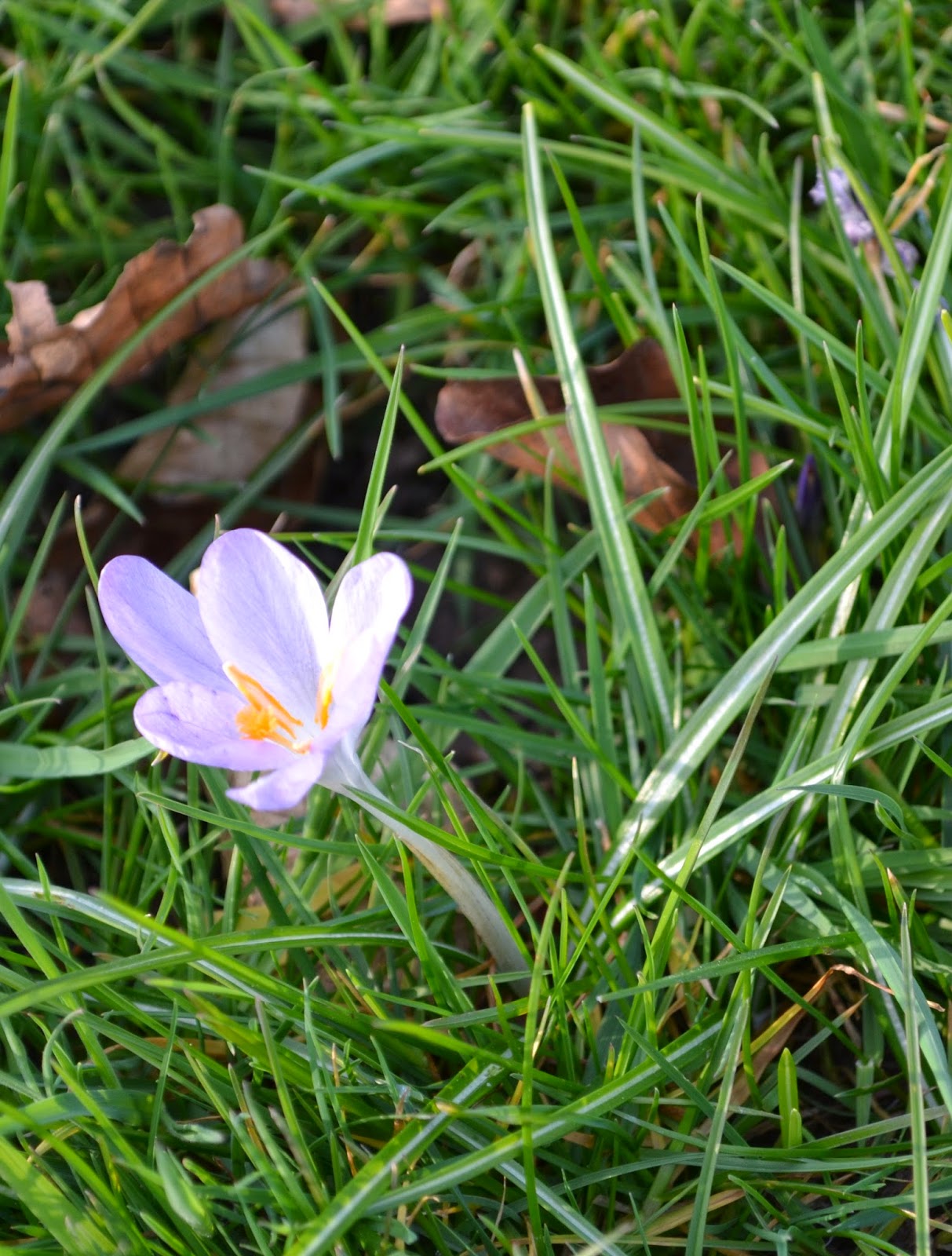
 Crocuses are also well naturalised here.  We were a little late for the early crocus Crocus tommasinianus which is perhaps the most extensively naturalised, as it is elsewhere, as it seems to spread readily by seed.  It was very evident along Princess Walk, but most of them were over.


Early crocus

The other crocuses were best seen in the length of grass extending east to Victoria Gate, where there were several varieties of the Dutch crocus C. vernus, including 'Purpureus Grandiflorus', the striped 'Pickwick' and the white 'Jeanne d'Arc'.


Crocuses 'Purpureus Grandiflorus' and 'Pickwick'

 The other bulbs of interest were the daffodils.  Our native Narcissus pseudonarcissus is naturalised at the Woodland Garden and many other places.

Narcissus pseudonarcissus

 The other possible native, Tenby daffodil N. obvallaris, is conspicuous at the north end of Princess Walk.  It has deep yellow petals, whereas pseudonarcissus has very pale ones.

Tenby daffodils

 The most extensively planted of the earlier-flowering daffodils here is, like everywhere else, 'February Gold', massed along Broad Walk and also in the formal planting of the Parterre in front of the Palm House.  Near Victoria Gate we also saw 'Topolino'.

'February Gold'

'Topolino'

 In the Conservation Area in the SW corner of the gardens, and around Queen Charlotte's Cottage, we also saw the odd specimen of 'Bridal Crown' and 'Telamonius Plenus', both of which have proliferating petals in the centre instead of a trumpet.

'Bridal Crown'

'Telamonius Plenus'

Otherwise the variety of daffodils in the open here was rather limited, compared, say, to Saville Gardens at Windsor.  More, however, were to be seen under glass in the Davies Alpine House by the Princess of Wales Conservatory.  Here were N. bulbocodium and N. jonquilla, both of which can survive here out-of-doors (although probably flowering later), along with N. fernandesii and N. papyraceus from the Iberian Peninsula, which may be more temperature sensitive.

Narcissus bulbocodium

 Narcissus jonquilla

 Narcissus fernandesii

 Narcissus papyraceus

 The other exotic plants on display here included many spectacular ones, such as the tulips Tulipa kaufmanniana, T. bakeri and T. aitchisonii; the crocus Romulea bulbocodium; and a yellow fritillary Fritillaria carica.

Tulipa aitchisonii

Fritillaria carica


Having had our fill of bulb-plants - the snowdrops were over, although there were some clumps of summer snowflake Leucojum aestivum - we could concentrate on other features of interest, such as the early-flowering shrubs.  There is a group of many varieties of magnolia just west of Princess Walk, and these were just now perfectly in flower.  They are not our favourite plant, but we had to admit this display was impressive, especially the conjunction against a blue sky of the pink M. campbellii and the white M. heptapeta.  They included one magnolia M. x kewensis named after Kew Gardens where it was developed as a hybrid between M. kobus and M. salicifolia (although this hybrid has been found in the wild in Japan).

Magnolia campbellii & heptapeta

Magnolia x kewensis

Magnolia sprengeri

In the Rhododendron Dell only a few bushes had yet begun flowering, namely the white R. fastuosum and the bright pink R. pulcherrimum.  Here (and elsewhere) was also the familiar Camellia japonica in the form of various cultivars.  Under them lungwort Pulmonaria officinalis was often the dominant ground plant.

Rhododendron fastuosum

Rhododendron pulcherrimum

Camellia japonica

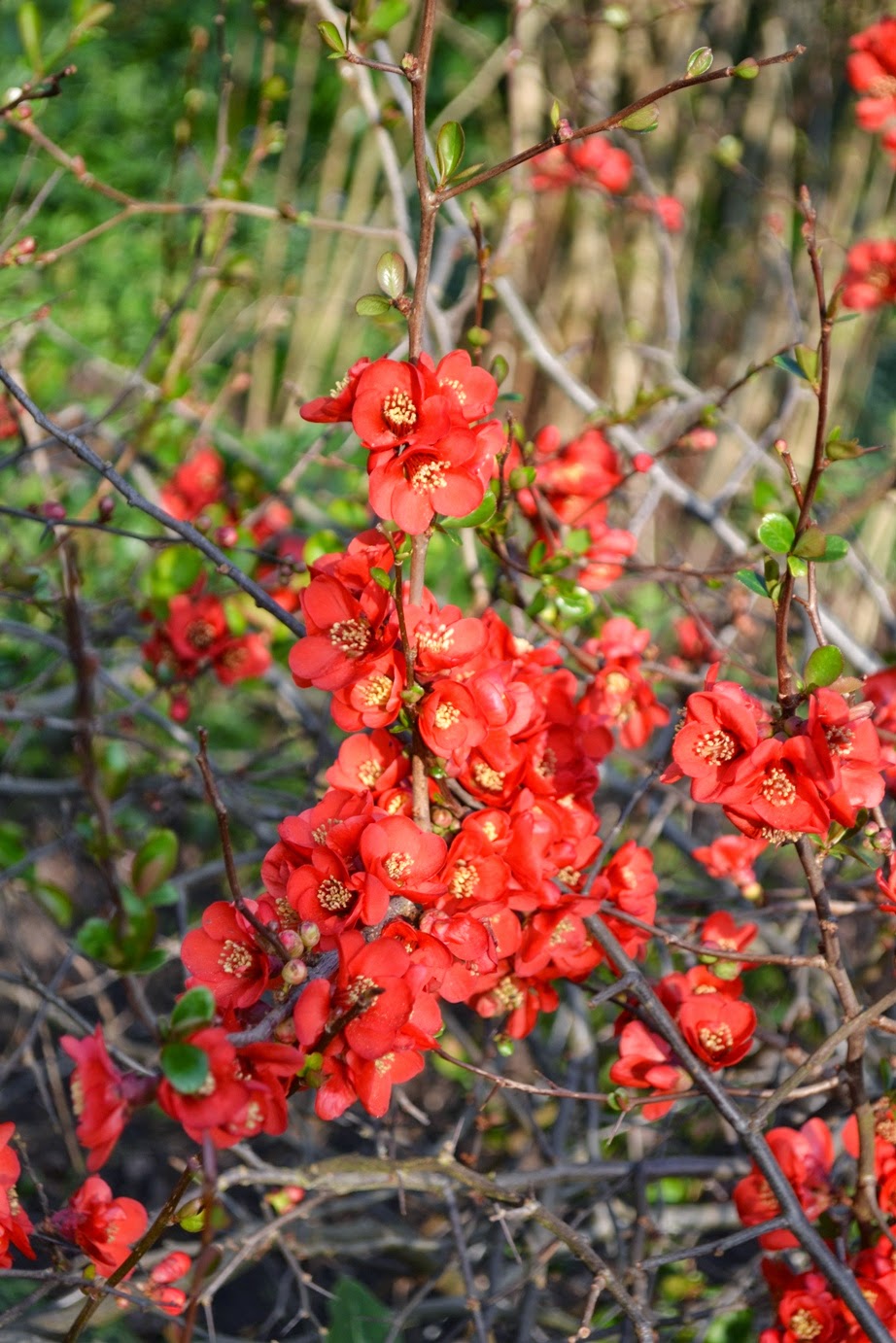
Other flowering shrubs around the gardens included Higan cherry Prunus subhirtella, popular with Japanese tourists, and the common garden quince Chaenomeles x superba 'Crimson & Gold'.

Higan cherry

Quince 'Crimson & Gold'

Low plants other than bulbs were not frequent - the only natives or long-established British plants in flower, other than lungwort, were daisy Bellis perennis, groundsel Senecio vulgaris, hairy bittercress Cardamine hirsuta, small nettle Urtica urens (abundant on bark mulch under some of the trees), and red dead-nettle Lamium purpureum.  Also on bark mulch in one spot was an unseasonal group of glistening inkcap Coprinus micaceus.

Red dead-nettle

Glistening inkcaps

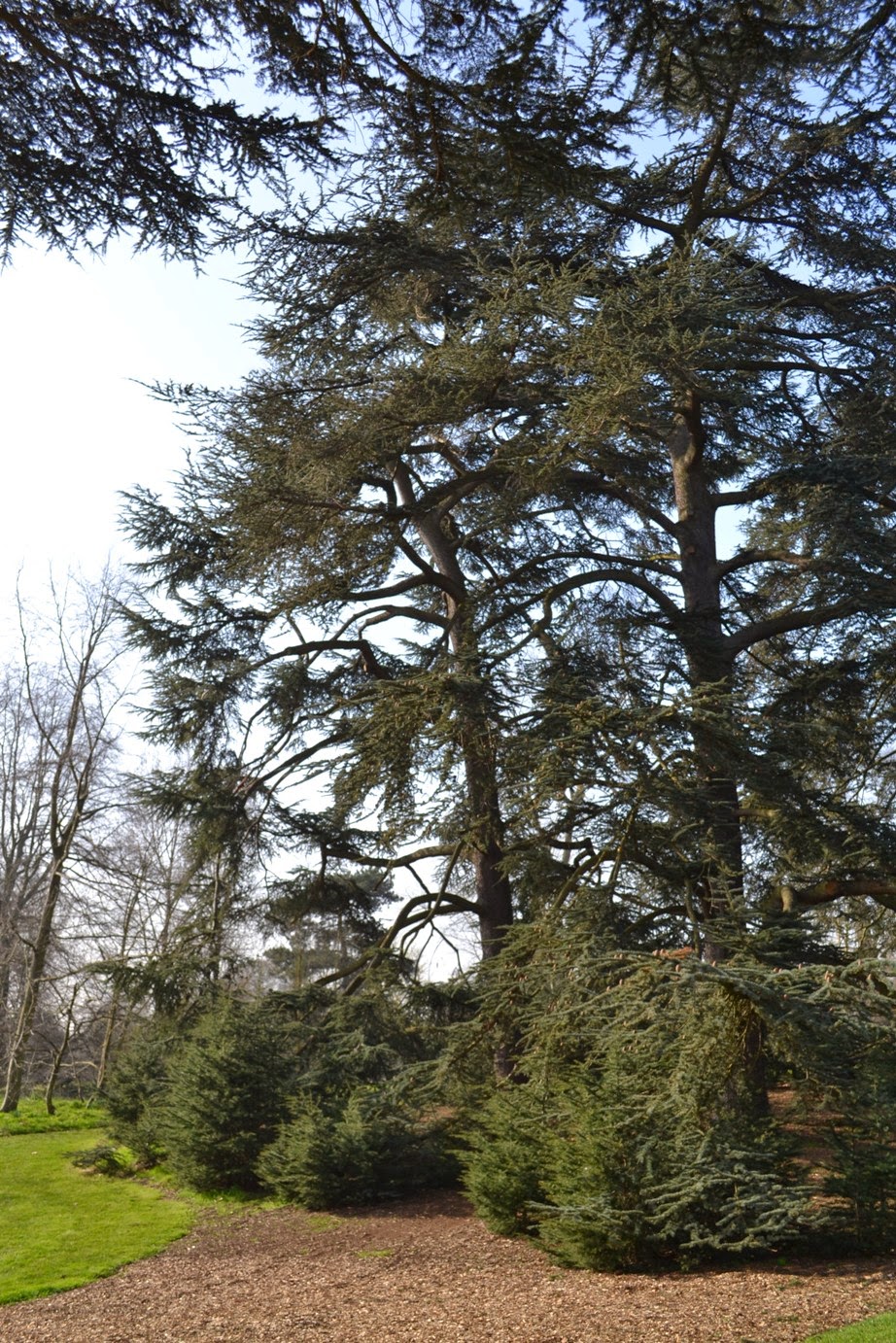
Although Kew Gardens does not date back as far as many other parks and arboreta, it still has many grand old "heritage" trees.  One group of Atlas cedars Cedrus atlantica was notable for having many young plants around them, showing that were capable of regenerating from seed and becoming naturalised.

Atlas cedars with regenerating offspring

A special tree is Turner's oak Quercus x turneri, a hybrid between our common Q. robur and evergreen oak Q. ilex, created in an Essex nursery in 1783.  The original specimen at Kew was planted in 1798 and is flourishing despite storm damage in 1987, after which supporting struts had to be put in.  It is 15m high.  Staff here have propagated many other specimens from this tree, and these can be seen around the gardens.  The leaves of this tree showed the mines of Ectoedemia heringiella, a Mediterranean moth feeding on evergreen oak, that was first seen in Britain as recently as 1996 (in the grounds of the Natural History Museum in London), but is increasingly widespread in the south.


Turner's oak planted 1798

Turner's oak leaves with mines of Ectoedemia heringella

Another hybrid oak commonly planted in the 18-19th centuries was Lucombe oak, and one planted here in 1776 is still doing well.

Lucombe oak planted 1776

Naturally there are several London planes Platanus x hispanica and one of its parents, oriental plane Platanus orientalis.  One of the latter here dates back to 1762.

Other trees we noted included swamp cypress Taxodium distichum, by the lakes, with its characteristic aerial shoots emerging from the water; Japanese pagoda tree Styphnolobium japonicum (from China!), of which a specimen here from 1760 is supported in an almost horizontal position and seems to have once been burned at the base; weeping beech Fagus sylvatica 'Pendula'; and an early C18th sweet chestnut Castanea sativa, the oldest tree at Kew.

Swamp cypress


Sweet chestnut, oldest tree at Kew

We paid a special visit after lunch at the Orangery Restaurant to the nearby rare Wollemi pine Wollemia nobilis, in its metal cage, where it was planted in 1997 shortly after its discovery in Australia, although only known previously from 2 million-year-old fossils.  We first saw it shortly after it was planted, dwarfed by its cage, but now it fills the protective cage and far overtops it, freely producing cones.  Seedlings are available in the garden shop (but could become very large trees!).


Wollemi pine cone

Apart from plants we also saw a variety of water birds around the lakes - Egyptian, Canada and greylag geese; mallard, pochard and tufted ducks; coot and moorhen.  With a previous week of sunshine various overwintering butterflies were flying, with brimstones particularly common.


Egyptian goose and brood

Greylag geese


Finally we should mention the imposing fungus sculptures made from willow twigs by Tom Hare, scattered in groups in the centre of the gardens, blending in well with the botanical scenery.

Tom Hare willow sculptures

Palm House and lake, Kew Gardens