About this Blog

This blog reflects our twin interests in walking and natural history, especially botany.


"Ich wandle unter Blumen

Und blühe selber mit ..."

Heinrich Heine


Walking is important to us as a way of being in direct touch with the environment, experiencing species and habitats in their ecological and historical context. By walking between different flower sites we experience the character of the general countryside, getting to know as much where flowers are not as where they are. Walking allows for the serendipitous - chance encounters with animals, meetings with local people, unexpected species - which enrich the experience.

We set up this blog to share a variety of mainly day-long walks centred on "iconic" flower sites and locations of rare plants, where these are publicly accessible. The accounts include descriptions of the routes taken, key plants seen, other wildlife encountered, and anything of general environmental or historical interest. All the walks allow time for looking around (some flowers need searching for), photography etc, and usually include a half-way stop for refreshment at some suitable establishment. The walks are seasonal, depending on the flowering/fruiting times of different species, although one cannot hit the peak time for all species seen on one walk, and the best timings will vary from year to year. Lengths vary but the walks may be anything up to 12 miles or more, so an early start is recommended.


A certain knowledge of our flora is assumed, but those less familiar should be able to identify most of the plants mentioned with the help of one of the good field guides - Blamey, Fitter and Fitter Wild Flowers of Britain & Ireland (A&C Black) or Francis Rose The Wild Flower Key (Warne) - although occasionally recourse may be needed to more technical tomes such as Clive Stace New Flora of the British Isles (Cambridge) or the specialist volumes published by BSBI (Botanical Society of the British Isles) on grasses, sedges, umbellifers etc.


While examining plants it is interesting to note the galls, leaf-mines and fungi (rusts etc) that are often specific to particular taxa. For galls we use Redfern and Shirley British Plant Galls, for leaf-mines http://www.ukflymines.co.uk/ (which also includes lepidopteran and other mines), and for fungi Ellis and Ellis Microfungi on Land Plants, although this is a technical tome rather than a field guide.

Our completed walk around the coast and borders of England is described on http://www.coastwalking.blogspot.co.uk/ and our current walk around the coast of Wales is on http://www.coastwalkwales.blogspot.co.uk/


Wednesday, 7 September 2011

Buckinghamshire: Dancers End to Hawridge Common

29 August 2011             OS Explorer 181 Chiltern Hills North
Length: All day

This day was rather more walk than flowers, but still had its moments.  The imminent onset of autumn was already obvious, with trees beginning to turn from green and fruits more prevalent than flowers.

Blackberries

We parked at the Wendover Woods car-park by Hengrove Wood SP898083 off the Aston Clinton-St Leonards road.  We walked back to the road and went left (north) to the second footpath on the right, just after a house.  This led across grassland to the corner of Bittams Wood (part of Dancers End Nature Reserve run by Berks Bucks & Oxon Wildlife Trust).  (This route to Dancers End is the same, in reverse, as that taken in our 21 June blog.)  The path follows the edge of the wood and then enters it, with the sound of roe deer barking immediately. 

 Beech yellowing in Bittams Wood

At cross-path we turned left along a wider grassy path with red bartsia Odontites vernus, eyebright Euphrasia nemorosa and lesser stitchwort Stellaria graminea.  At the junction with another track we turned right and then immediately followed a smaller path on the left.  This eventually leads to a gate into a grazed area of scrubland and then through a further gate into a grass ride, across which are a series of grazed meadows.  Here we had used to see plentiful Chiltern gentians Gentianella germanica. 

Chiltern gentian

Apart from large thyme Thymus pulegioides on the anthills, there was little notable at this time and only scattered Chiltern gentians.  We then exited the reserve at the east end, where the ride leads to a gate and a sunken way down to the road at Ebb’s Pit.
          At the lane we turned right and passed on the right-hand hedgebank fruits of dewberry Rubus caesius, fronds of Stagshorn sumach Rhus typhina and a pale pink variety of purple toadflax Linaria purpurea, the last two presumably seeded from a nearby garden.  We immediately took a path on the left through a group of trees into a rough arable field with much black grass Alopecurus myosuroides, soft brome Bromus hordeaceus, common poppy Papaver rhoeas, field pansy Viola arvensis and small toadflax Chaenorhinum minus.  Across another arable field and pasture the path led to a lane where we turned right, past lots of wood melick Melica uniflora on the banks and many young pheasants running everywhere.  Just after Painsend Farm, where the lane turns sharp left, we turned right along a bridleway and took a left fork along a footpath up into Pavis Wood, past some large stands of gooseberry Rives uva-crispa.  Our pleasure at leaving the muddy bridleway churned up by horses was muted by the fact that riders had also been using this footpath and turning that also into a quagmire.  The wood is largely young tree growth over dog’s mercury Mercurialis perennis.  There were few plants of note except a few elegant St John’s-wort Hypericum pulchrum. 

Pavis Wood

At the top of the wood we crossed the Ridgeway and carried on the same footpath out of the wood and then across a very large field of flax now all in fruit and brown.  We saw one plant of field pennycress Thlaspi arvense, a supposedly common plant which we actually see only rarely in this area.  We eventually reached a track where we turned left.  This track follows the line of Grim’s Ditch, although it is no longer evident along here.  At Shire Lane we turned right, now following the Bucks-Herts county boundary.  (We saw from the map afterwards that if we had digressed slightly left along Shire Lane
and then taken a footpath to the right we would have reached a section of Grim’s Ditch – in Herts - with surviving embankments.)  Continuing SE the lane enters Drayton Wood and here there were ditches and embankments on each side, the banks topped by formerly laid old trees, marking well the ancient county boundary.  At one point the way between the ditches was very wide – about 14 metres – making a very wide boundary track.  Along here was yellow pimpernel Lysimachia nemorum.  Where the wood was replaced by a field on the left-hand side the right-hand bank of the continuing wood-edge had spikes of violet helleborine Epipactis purpurata in seed but still obvious from their purple-tinted stems and leaves and their tendency to occur in clumps.  At a footpath just before the village of Cholesbury we turned right and crossed the wood, but here the vegetation included hartstongue fern Phyllitis scolopendrium,  wild angelica Angelica sylvestris, and tufted hairgrass Deschampsia cespitosa. It was dominated however by introduced species like pendulous sedge Carex pendula, snowberry Symphoricarpos albus, large bindweed Calystegia silvatica, and Japanese knotweed Fallopia japonica, the latter in flower, the white spikes standing both erect and hanging vertically down.
Path through Drayton Wood

Japanese knotweed

Near the far edge of the wood we turned left along another path, across another path and out of the wood into a horse pasture with abundant common ragwort Senecio jacobaea (strange how the British Horse Society promotes the destruction of this plant on other people’s land, while their members never seem bothered on their own). 

Horse among ragwort

We then went along the edge of another small wood, where there was another garden escape, Canadian goldenrod Solidago canadensis, visited by hoverflies like Leucozona lucorum. 

Leucozona lucorum on Canadian goldenrod

Across another field we entered the very deep ditch and steep embankments of Cholesbury Fort, a roughly circular Iron Age fortified settlement of around 0 AD, still surviving remarkably well around most of the perimeter except at the south end where a church and a few houses have obliterated it. An interpretation board stands on the gate immediately ahead.  We turned left here, however, and walked around the embankment on its northern and eastern sides.  Along the banks the main ground vegetation consisted of clumps of great wood-rush Luzula sylvatica, a plant that is very scarce in this region, but obviously thriving here. 

Cholesbury Fort ditch with clumps of great wood-rush

Eventually the path leaves the embankment and leads to the back of the church, where there is a path into the road through Cholesbury.  We passed stalls being set up on a wide green for an impending village fête (it was August Bank Holiday) and then took a road off right.  Here we passed a former pond with water mint Mentha aquatica and reed sweet-grass Glyceria maxima, but now unfortunately mostly covered by a black plastic sheet weighted down by paving slabs in an attempt to destroy an invasion of New Zealand pigmyweed Crassula helmsii. 
At the bottom of this lane we took the bridleway to the right, again following the county boundary along the edge of Cholesbury Common, wooded mostly with oak Quercus robur and birch Betula pendula.  This eventually leads into a more open section dominated by bracken, the beginning of Hawridge Common. 

Hawridge Common

Already autumn fungi were beginning to appear, such as the blusher Amanita rubescens, the small pinkish scurfy twiglet Tubaria furfuracea and small oyster Pleurotus pulmonarius.  At a road, we went briefly left and then right along a footpath into a wooded part of the common.  Here there were some impressive old hawthorn trees Crataegus monogyna, the plant which of course gave the village of Hawridge its name. 

Old hawthorn, Hawridge Common

Haws

After seeing these, and some nearby red currant Ribes rubrum, we took a path across to the west side of the common (some small balsam Impatiens parviflora invading here) and the Hawridge-Cholesbury road.  We walked back northwards along here until we were again at the outskirts of Cholesbury where the Full Moon pub (describing itself as a 17th century coaching inn), with an old windmill just visible behind, provided a resting-place for lunch with friendly service, with a choice of restaurant, bar or benches outside.


Cholesbury windmill

Leaving the Full Moon towards Cholesbury we turned left at the first road, from which one can see down the drive towards the windmill, which is now used as a private residence.  At the second bend, where the road goes downhill, we took the path to the right across pasture and a taller grass field that had lots of burnet saxifrage Pimpinella saxifraga and a few fungi like Entoloma lucidum and fool’s funnel Clitocybe rivulosa.  The un-harvested bean field that followed, with its blackened pods, had some parsley piert Aphanes arvensis.  The path beyond is tightly confined between a barbed wire fence and garden fences, over which most householders were illegally throwing their garden waste, creating banks of nettles even more constricting the path.  In the following horse pasture the path bends to the left and eventually reaches a small lane where we turned right and then left along a bridleway (Chiltern Way).  At first this path is surfaced as it passes through an avenue of beeches Fagus sylvatica beside Dundridge Manor, originally an early medieval moated farmstead.  The path is known as The Green and was part of an ancient road all the way from Missenden Abbey to St Albans, Dundridge being part of the Abbey lands.  

Avenue
of beech, Dundridge Manor

The current house is largely 17th century with 19th century facings.  The moat had silted up but has recently been renewed to an impressive depth, although a modern faux draw-bridge has been added. 

Mock drawbridge

One of the old beeches had large brackets of dryad’s saddle fungus Polyporus squamosus, which causes a white rot. 

Dryad’s saddle

Underneath the trees was a lot of sanicle Sanicula europaea in fruit.  After the manor the path becomes a wide grassy glade between hedges screening arable fields.
This track continues along the southern edge of Ashen Grove.  Here, well protected by thickets of holly, grows Britain’s tallest rowan Sorbus aucuparia, 28 metres high, at approximately SP913066 (first discovered by John Morris of the Chiltern Woodland Group).  Its girth of less than 2 metres indicates that it is of similar age to the surrounding beech plantation, probably dating back 150 years, so its height presumably comes from competition with the beech.  It is far from the widest or oldest rowan in Britain, but it has reached a girth that most rowans do not achieve, not being normally a long-living tree.  It is much branched and apparently healthy with a good crop of berries high in the canopy, which helped us to pick out the tree.

Britain’s tallest rowan

Rowan berries

The track then follows the northern edge of the adjoining Stonehill Wood.  Near a house at the end of this wood, where the path joins a road, stands a large old hornbeam Carpinus betulus with “witches’ brooms”, bunches of short thick leafy twigs, caused by the ascomycete fungus Taphrina carpini, closely related to the one that commonly causes similar phenomena on birch trees, but this species specific to hornbeam. 

Witches’ broom on hornbeam

Here we turned left along the road.  On the steep bank on the right-hand side under an old oak was a specimen of the uncommon “lurid bolete” Boletus luridus, a cep-like fungus with red and yellow stem that gets its name from the fact that, when cut, the flesh inside rapidly becomes an intense blue.  The cap was entirely eaten away with small bite-marks, presumably a small rodent (not like the patches eaten by slugs).

Lurid bolete

Also along this road was a neat pair of Panaeolus papilonaceus toadstools.  Immediately after a road to the left signed to The Lee there is a footpath again off to the left along the edge of a cornfield and into Baldwin’s Wood.  (The Lee has a vicarious claim to some botanical fame in being the place of origin of the apple variety called “Bazeley”, a corruption of “best of The Lee”.  Unfortunately we do not currently know of a specimen of this old variety extant at the village, although a few still survive elsewhere locally.)
In Baldwin’s Wood was more yellow pimpernel surviving in what is now largely a larch plantation.  There was also some rowan and plenty of ferns, not only the dark green fronds of broad buckler Dryopteris dilatata and clumps of male fern D. filix-mas, but also some clumps of the locally uncommon golden-scaled male fern D. affinis.  We followed the path straight across the wood, keeping W to NW, with some difficulty, as there are more paths than indicated on the OS map.  Towards the NW edge we took a path to the left following the edge until we emerged on a wide muddy track which we took to the right out of the wood over a wide ditch, which is a remnant of the same Grim’s Ditch along whose line we had briefly walked in the morning.  It is wider and deeper than a normal wood-boundary ditch would be.  We then went diagonally across a wheat-field, past an isolated house and into Hale Wood, which covers a steep chalk slope.  We descended a little way to the bridleway (the Ridgeway path once more) that proceeds along its length, turned right and followed it, past more clumps of gooseberry, to a road where we took a short right before continuing the Ridgeway trail on the left through more woodland.  Here there was some wood barley Hordelymus europaeus, sanicle, wood-sorrel Oxalis acetosella and woodruff Galium odoratum. 
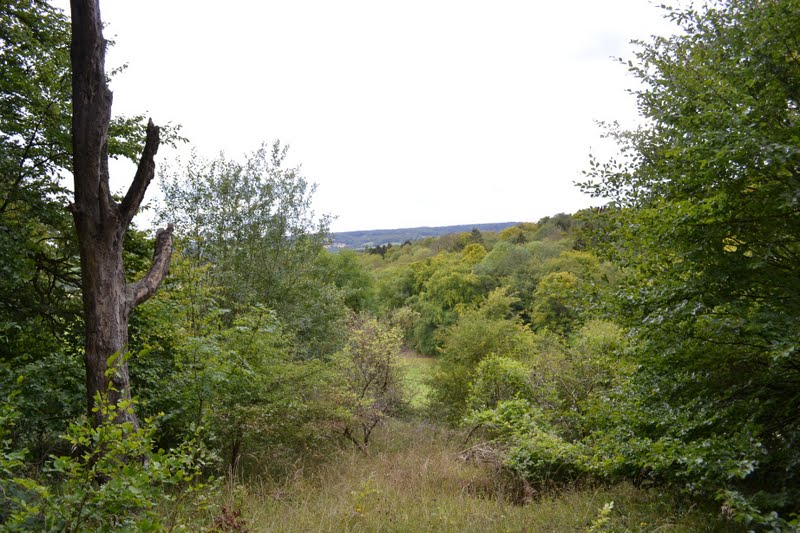
View from Hale Wood

The Ridgeway bends sharply down to join the Icknield Way, running along a deep valley below, but we carried on at the same level by a footpath which brought us to the Icknield Way higher up.  Here we had to descend the steep bank to the Icknield Way
and up the bank opposite to enter Wendover Woods by a well-signed path that is not marked on the OS map.  Here a dor beetle Geotrupes stercorarius flew into us, a large black beetle with a beautiful purple-blue sheen in the light.  It is a type of burying beetle that stores dung for its underground larvae.  There is a plentiful supply of this essential material from the well-used horse-trails around here.  This path took us north, by the edge of Hengrove Wood to surfaced road where we turned right to return to the car-park where we started.  Along here the road edge again has lots of violet helleborine spikes, almost all in seed although a couple still had recognisable flowers still out at the very tip.
Violet helleborine fruiting-spikes

Tuesday, 30 August 2011

Buckinghamshire: Radnage to West Wycombe: Chiltern Gentians

22 August 2011   OS Explorer 171 & 172 Chiltern Hills West & East
Length: All day

This walk is constructed around three classic Chiltern gentian Gentianella germanica sites.  It is also a pleasant and scenic walk for its own sake.
          We parked by Radnage church SU786979.  The name of this tiny village derives from the Anglo-Saxon rēad āc “red oak-tree”.  It seems unlikely this would refer at such an early date to the alien species “red oak”, more likely a distinctive native oak-tree with reddish bark or leaves, or one marked with a red design.  Such a tree, however, would presumably have been lost long ago, although pedunculate oaks Quercus robur are of course still frequent in the vicinity.  The Church of St Mary seems to date back at least to the 13th century and contains some 16th century wall paintings.  It has a low square central tower and featured in the film “Month in the Country”.  The man who is said to have killed the last wild bear in England is buried to the left of the church door, the gravestone showing a man hunting bear with bow and arrow.

Radnage Church

A footpath (Chiltern Way) leads through the churchyard itself, which is creditably managed leaving plenty of longer grass.  To the accompaniment of red kites mewing loudly (we had good views of them most of the day), we noticed that lily-of-the-valley Convallaria majalis had spread across two graves and was well-established; other plants we saw included harebell Campanula rotundifolia, dark mullein Verbascum nigrum, burnet saxifrage Pimpinella saxifraga, salad burnet Sanguisorba minor, marjoram Origanum vulgare, common (mostly) and chalk knapweeds Centaurea nigra & debauxii, green alkanet Pentaglottis sempervirens, wild basil Clinopodium vulgare, and nettle-leaved bellflower Campanula trachelium showing that the soil here is chalky, and these were all plants we would see regularly the rest of the day. 

Harebell

The church walls were kept well cleaned of plants, but a little hartstongue fern Phyllitis scolopendrium survived at the base of one wall with pellitory-of-the-wall Parietaria judaica and wall lettuce Mycelis muralis.  Hedge browns were already flying at 9.30am.
          After leaving the churchyard by a stone stile the path crosses two pastures to a stile where two paths diverged.  We took the left-hand one up to the gate giving access to Yoesden Bank on the left. 

Yoesden Bank

This is a botanically-rich chalk slope managed by Bucks County Council.  Apart from the common chalk flowers above, there was an abundance of rest-harrow Ononis repens, plus eyebright Euphrasia nemorosa, wild thyme Thymus polytrichus, small scabious Scabiosa columbaria, quaking-grass Briza media, dwarf thistle Cirsium acaule, yellowwort Blackstonia perfoliata, common spotted orchid Dactylorhiza fuchsii and white helleborine Cephalanthera damasonium and several other orchids in fruit, and kidney vetch Anthyllis vulneraria. 
Rest-harrow

Dwarf thistle

Chiltern gentians were abundant but more scattered along this long hillside than at many sites, along with smaller hybrid gentians Gentianella x pamplinii, although no true autumn gentians G. amarella. 
Chiltern gentian

Active here were Roesel’s bush-cricket, sloe bugs Dolycoris baccarum, many butterflies – meadow and hedge browns, common and chalkhill blues, and small heath, and heath snails Helicella itala typical of this habitat (despite the English name) and distinctive with their wide umbilicus.
Sloe bug

Chalkhill blue

Small heath

10 Heath snail (upper side)

Heath snail (lower side)

Having explored here a while we returned to the path, which continued up the slope into an area of scrub with devilsbit scabious Succisa pratensis, nettle-leaved bellflower, dewberry Rubus caesius, rock-rose Helianthemum nummularium and more Chiltern gentians.  
Devilsbit scabious

Rock-rose & marjoram

By the path the woolly galls that commonly infest marjoram were obvious, caused by the mite Aceria origani.  We continued to follow the Chiltern Way through some trees and along a double hedgerow separating agricultural fields.  This soon led to the main road through Bledlow Ridge, where we left the Chiltern Way and turned right along the road a little way until another footpath departed on the right, past houses and gardens and then diagonally across a field. 

View from below Bledlow Ridge to Saunderton Lee & Bradenham Woods

Where it meets a hedge we kept to the west side (the path was not all that clear here), and continued downhill through pasture with few flowers but some dwarf thistles, followed by a former field of oil-seed-rape marked by a forest of dry stalks under which there was a carpet of new rape growth giving off an unpleasant cabbage smell as we walked across.  Passing under a line of pylons we reached an isolated pair of houses with a surfaced track which we took to the right leading to Haw Lane.  Here we turned left and walked up a slight slope, with dark mullein on the verge, until a footpath came off on the right going up Slough Hill.  We passed a pretty shrub of guelder rose Viburnum opulus with its bright red berries and then typical chalk plants of long grass all the way to the top of the hill – pleasant and full of butterflies, even if nothing specially notable.  At the top of the hill, just past a hedge, a footpath goes diagonally across a field to a small road.  The field had just been ploughed, however, and the path unmarked.  We fortunately estimated the direction near enough, aiming for a large gap in the hedge at the bottom, near which we found the exit to a bend in the lane where we continued left along the lane.  The lane leads under a railway bridge and into Saunderton.
          Here we directly crossed the busy A4010 (Bradenham Road) and went straight up Smalldean Lane to the eponymous farm, where a footpath to the right goes through the farmyard and left up the hill to the edge of Park Wood above. 

Small Dean Farm

The path then follows the wood-edge along a wide strip of rough grassland between the wood and ploughed fields for about a kilometre. 

Edge of Park Wood

Again there was a common chalk flora, plus yellowwort, common spotted orchid, common centaury and brown spikes of old clover broomrapes Orobanche minor in one large patch. The field edge had few arable annuals except lots of dwarf spurge Euphorbia exigua.  Having turned a corner of the wood we passed a little rock-rose and entered a small chalk bank with a few dozen Chiltern gentians.  After more wood-edge with brimstone butterflies the path gently descended through arable fields along a comfortable wide grassy verge.  While not botanically rich this is a very pleasant walk with wide views and Bradenham Manor among the trees ahead.  The cultivated land had a few more plants, including small toadflax Chaenorhinum minus, field pansy Viola arvensis, field madder Sherardia arvensis, and scarlet pimpernel Anagallis arvensis.
          At Bradenham we crossed the road and walked along the edge of the mown grass in front of the churchyard (and the flowering crab-tree festooned with mistletoe Viscum album featured in our Post for 19 April 2011), and round two sides of the Manor.  Here we reached the woods and took the right-hand footpath into Pimlocks Wood and then a long walk through Kit’s Wood, with some sizable beech Fagus sylvatica and oak trees, wild cherry Prunus avium and holly Ilex aquifolium, and spikes of wood-barley Hordelymus europaeus.  
Kit’s Wood

A roe deer passed quickly ahead of us and out of view, and speckled woods passed by frequently.  Having reached the east edge of Kit’s Wood at its lowest end, before a fence starts on the right of the path, it is possible to walk through the trees on that side towards grassy glades visible beyond them.  These glades have a chalk grassland flora and wind between clumps of scrub until one finds one’s way, somewhat by trial and error, to a wider chalk slope which has hundreds of clustered bellflower Campanula glomerata on the lower slope and a good number of Chiltern gentians on the upper part among a lot of dwarf thistle.  
Clustered bellflower

Chiltern gentian

There was also yellowwort, ploughman’s spikenard Inula conyza, chalk knapweed and large thyme Thymus pulegioides.

Chalk knapweed

Returning to the path we left Kit’s Wood and came to the railway line where there is normally a crossing, the path continuing on the other side directly to West Wycombe.  This was fenced off, however, and an easy but dull stone track has been laid along the east side of the line 500 metres south to another path which crosses underneath a bridge and then crosses a cornfield to the A4010 road.  In this field we passed a few clumps of the coarse alien grass cockspur Echinocloa crus-galli.  This is occasionally seen on waste-dumps from discarded bird-seed.  Here it probably derives from a seed-mixture used for feeding game-birds nearby, spread by birds or muddy boots. 

Cockspur grass

Crossing the road the path goes along a hedgerow under a grand row of fruiting hornbeam Carpinus betulus boughs. 

Row of hornbeams

This path emerges into Church Lane, West Wycombe, and we turned left to follow it down to the main road (A40) in the centre of the village.  Opposite is the George and Dragon and a welcome chance of rest and refreshment.
          Leaving the pub along the road to the west to the end of the village, we had a choice of a path up past the Mausoleum on top of West Wycombe Hill and along the ridge, or walking beside the road off to the right past the garden centre.  With a stomach full of sausages and mash we opted for the easier road option, which proved fortuitous.  (The route along the ridge is covered by our Post for 19 April 2011.)  Just before we reached a row of houses on the right there was scrub with lots of traveller’s joy Clematis vitalba just at its flowering peak (aptly named for walkers), but also a wide patch of tall mint Mentha x smithiana, a garden escape but well-established here. 

29red Traveller’s joy

Tall mint

We also came across a low plant of vervain Verbena officinalis that had just survived road-verge cutting, and hedgerow cranesbill Geranium pyrenaicum.  Passing the houses we also saw several spikes of hollyhock Alcea rosea, more garden escapes, on the left-hand side of the road.  But it was just at the end of the houses that we noticed a plant of horse-radish Armoracia rusticana conspicuous for the number of snails on its leaves.  We were surprised to find that among the snails were many pointed (or sandhill) snails Cochlicella acuta normally only found on the coast, where they are common. 

V5 Pointed snails

Michael Kerney’s “Atlas of the Land and Freshwater Molluscs of Britain and Ireland” says that these snails are rarely introduced further inland and then they do not last long.  He does however include a 1988 record for West Wycombe!  Obviously this is an exceptionally long-lasting inland colony.  We found the living snails and plenty of old shells for some way along the road after this spot, on all sorts of vegetation.  Also on the horse-radish were the small dark blue leaf-beetles Psylliodes napi which are common on a wide range of plants in the cabbage or crucifer family.
          At the crossroads we took the right-hand road, Slough Lane, a narrow but very quiet lane with little traffic. 

Path to Buttler’s Hangings

We ascended the footpath on the right between double hedges and entered another chalk bank, which was until recently the Buttler’s Hangings Nature Reserve of the Berks, Bucks and Oxon Wildlife Trust until there were difficulties over continuing the lease.  The reserve is now becoming scrubbier, but it still contains important flora and fauna.  Chiltern gentians occur densely here in their thousands, even growing in the steps of the path as it goes up the south end of the bank. 

Dense Chiltern gentians

As well as chalk flowers already found frequently, there were carline thistle Carlina vulgaris, small scabious, rest-harrow, blue fleabane Erigeron acer, wild thyme, rock-rose, devilsbit scabious, sweetbriar Rosa rubiginosa with erect sepals on the hips, chalk knapweed, common centaury, glaucous sedge Carex flacca, and squinancywort Asperula cynanchina on ant-hills becoming swamped by more vigorous vegetation.

Carline thistle

Blue fleabane

Chalk knapweed

Common centaury

Among the butterflies were brown argus and large skipper.  A fungus growing not too far from the wood-edge (and probably associated with beech-tree roots) was Boletus fechtneri, one of those with bulky stems, bright yellow at the top, and a light grey-brown cap sticky after the rain, the pale flesh turning slightly blue in part of the upper stem on cutting.  There are few records of this fungus but it is thought to be under-recorded (possibly because it is not illustrated in any of the usual field-guides). 

Boletus fechtneri

Bedeguar galls (robin’s pincushions) are familiar on rose bushes, usually on the stems: here we found them also on the sepals of hips.  Rose sawfly caterpillars ate statuesquely on the leaves.

Bedeguar gall on hip

Rose sawfly larvae

A wooden seat celebrates the haiku writer Norman Barraclough:
“Sawn down hawthorn
orchids flowering through its shadow”.

Barraclough seat

One could spend much more time exploring here, as this is another large site, but we had to return to the footpath and go back downhill to the road. 

Leaving Buttler’s Hangings

This time we chose to walk beside the cultivated field rather than between the hedgerows and came across musk mallow Malva moschata, an apparently misplaced Chiltern gentian, wild mignonette Reseda lutea, hop trefoil Trifolium campestre and some yellow chamomile Anthemis tinctoria, like a small corn marigold but with pinnate leaves. 

Yellow chamomile

We continued up the lane to Slough Bottom Farm, opposite which is a footpath on the left going straight uphill to Bledlow Ridge.  There was little to retain our interest here except a lone specimen of the yellow-stainer mushroom Agaricus xanthodermus. 

Yellow stainer

The path becomes a surfaced lane and then leads into Chinnor Road along the top of the ridge.  Here we turned right into the village of Bledlow Ridge.  We passed the first footpath at the edge of an elaborate children’s playground and took the next one, a bridleway, just before a road junction.  Where the track leaves the housing we took the right turn off the bridleway along a footpath that descends and then cuts around the rolling hills below Bledlow Ridge.  There was common cornsalad Valerianella locusta at the edge of one of the arable fields here.  The path then skirts Yoesden Wood where there is rock-rose and wood barley on the bank. A comma butterfly flew over the flowers of rest-harrow and devilsbit scabious along the path, which soon leads to the gate below Yoesden Bank where we had arrived from Radnage Church at the beginning of the walk, so it was only a short way back to the car.  Looking back up at Yoesden Bank it seemed remarkably dull – pale browns and greens interrupted by small dark bushes – giving no hint of the colour and variety to be seen at close quarters.