About this Blog

This blog reflects our twin interests in walking and natural history, especially botany.


"Ich wandle unter Blumen

Und blühe selber mit ..."

Heinrich Heine


Walking is important to us as a way of being in direct touch with the environment, experiencing species and habitats in their ecological and historical context. By walking between different flower sites we experience the character of the general countryside, getting to know as much where flowers are not as where they are. Walking allows for the serendipitous - chance encounters with animals, meetings with local people, unexpected species - which enrich the experience.

We set up this blog to share a variety of mainly day-long walks centred on "iconic" flower sites and locations of rare plants, where these are publicly accessible. The accounts include descriptions of the routes taken, key plants seen, other wildlife encountered, and anything of general environmental or historical interest. All the walks allow time for looking around (some flowers need searching for), photography etc, and usually include a half-way stop for refreshment at some suitable establishment. The walks are seasonal, depending on the flowering/fruiting times of different species, although one cannot hit the peak time for all species seen on one walk, and the best timings will vary from year to year. Lengths vary but the walks may be anything up to 12 miles or more, so an early start is recommended.


A certain knowledge of our flora is assumed, but those less familiar should be able to identify most of the plants mentioned with the help of one of the good field guides - Blamey, Fitter and Fitter Wild Flowers of Britain & Ireland (A&C Black) or Francis Rose The Wild Flower Key (Warne) - although occasionally recourse may be needed to more technical tomes such as Clive Stace New Flora of the British Isles (Cambridge) or the specialist volumes published by BSBI (Botanical Society of the British Isles) on grasses, sedges, umbellifers etc.


While examining plants it is interesting to note the galls, leaf-mines and fungi (rusts etc) that are often specific to particular taxa. For galls we use Redfern and Shirley British Plant Galls, for leaf-mines http://www.ukflymines.co.uk/ (which also includes lepidopteran and other mines), and for fungi Ellis and Ellis Microfungi on Land Plants, although this is a technical tome rather than a field guide.

Our completed walk around the coast and borders of England is described on http://www.coastwalking.blogspot.co.uk/ and our current walk around the coast of Wales is on http://www.coastwalkwales.blogspot.co.uk/


Saturday, 2 June 2012

Oxfordshire: Chiltern Bluebell Woods

23rd May 2012                         OS Explorer 171 Chiltern Hills West
Length: All day.

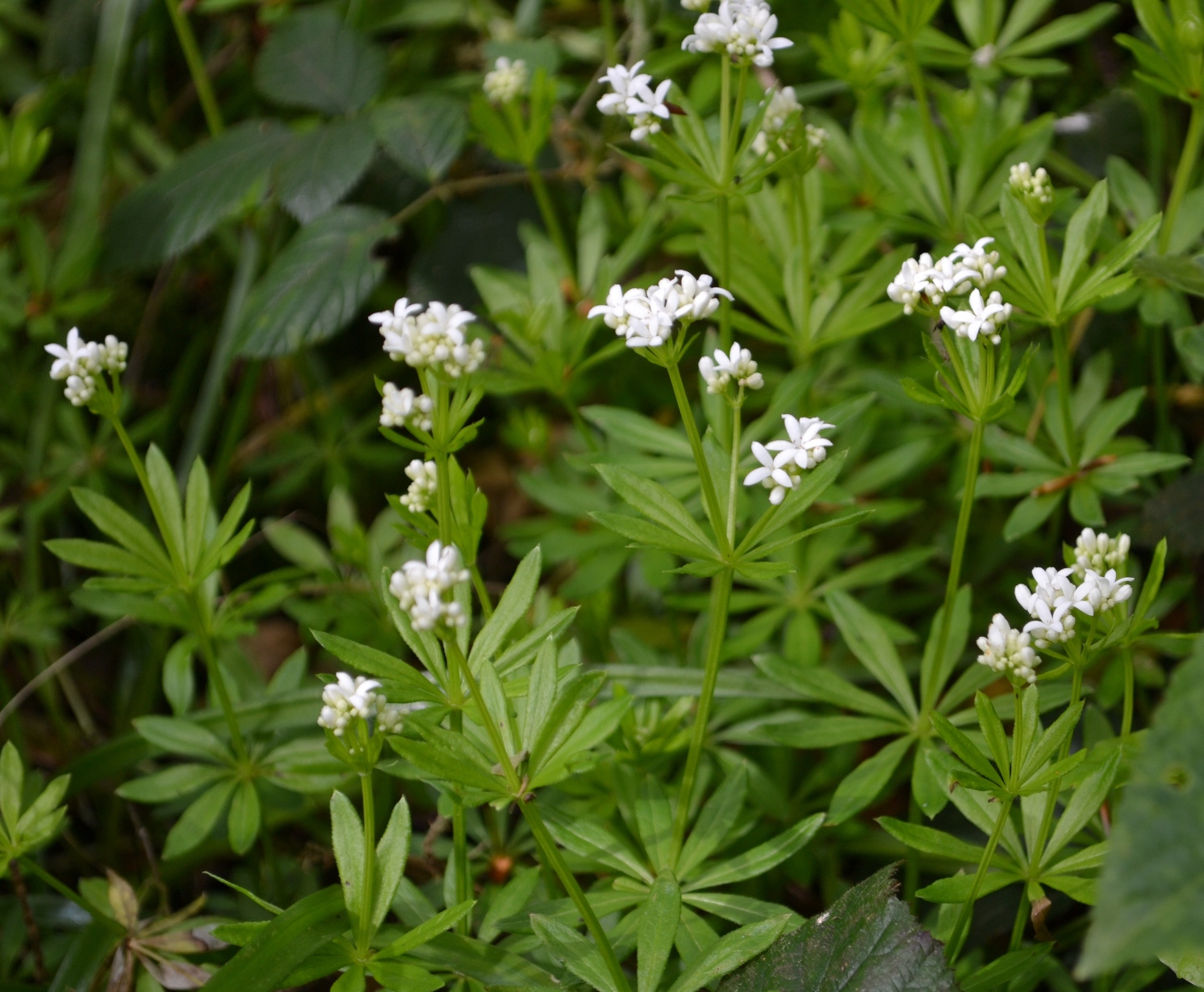
We parked at Ipsden Heath by Southdown Road at SU667857, and walked south down the road through a wood owned by the Woodland Trust and notable for its bluebells Hyacinthoides non-scripta, yellow archangel Lamiastrum galeobdolon montanum and woodruff Galium odorata. 
Ipsden Heath

Bluebells, Ipsden Heath

Yellow archangel

There was also sanicle Sanicula europaea, enchanter’s nightshade Circaea lutetiana, wood melick Melica uniflora, wood sedge Carex sylvatica and the leaves of wood anemone Anemone nemorosa, which we were to see regularly through the woods today, although they have become rare in some other parts of the Chilterns.  Very few were in flower at this date, but some had seed-heads, although they do seem to flower sparingly in this area, perhaps the reason why they are becoming less common.  On a sunny day, unusually warm for May, speckled wood butterflies were active, well matched to the dappled shade of the beeches Fagus sylvatica. 

Speckled wood on greater stitchwort

We kept straight on at the junction with Kit Lane just south of Ipsden Heath Farm, on the left hand side of the road a few old stems of Brussel sprouts Brassica oleracea var gemmifera had been dumped in the edge of the wood last year and one of these had managed to root and had grown a magnificent flowering stem! 

Brussel sprout flowering

Brussel sprout flower

On the other side of the road someone had also dumped at some time garden yellow archangel Lamiastrum galeobdolon argentatum, for there was a large patch established here.  We hope it does not oust the native species.
          [A better alternative at the junction with Kit Lane is to take the path that starts opposite this road and leads to an exit on the south edge of the Woodland Trust area on the Quiet Lane below.  This passes a number of notable and veteran trees.]
          At a crossroads we turned right down what is designated a “Quiet Lane”, although this designation seems to be more of an aspiration that an achievement when motor traffic is still allowed with no speed limit.  At the corner was a bank with wild strawberry Fragaria vesca and greater stitchwort Stellaria holostea.  Down this lane the path mentioned in square brackets above emerges from the wood.  The lane continues through woodlands adjacent to Ipsden Heath and at the first junction we turned sharp left and then first right, finally taking the footpath on the left that passes through Yewtree Brow, following a forestry track. 

Yewtree Brow wood

This is heavily rutted but one is following the bottom of a valley with beautiful flowery slopes of bluebells and other spring flowers rising on each side, which have no doubt benefited from the recent extraction of the alien pines. 

Bluebells, Yewtree Brow

The downside of the forestry activity, however, was the frequent shoots of Indian balsam Impatiens glandulifera appearing by the track throughout the wood – no doubt the seeds are being carried in the mud on vehicle tyres and are thus well distributed.  This could become a major nuisance.
Near the entrance, coming up by a pile of pine logs, were several spikes of Solomon’s seal, unfortunately, though not surprisingly, the garden variety with ridged stems and larger flowers Polygonatum x hybridum, the native plant being extremely rare hereabouts these days. 
Garden Solomon’s-seal

One of the native plants doing particularly well along here was yellow pimpernel Lysimachia nemorum, which formed large patches with dense displays of bright flowers.  We have never seen such a good display of this plant before. 

Yellow pimpernel patch

Yellow pimpernel

Several patches of tall spikes of bugle Ajuga reptans added to the colour, especially with the bluebells beginning to go over. 

Bugle

Although too late for the flowers, there were many patches of wood-sorrel Oxalis acetosella.  There was the odd stand of redcurrant Ribes rubrum.  There was also a little red campion Silene dioica, a flower we used to take as common but which seems more restricted these days. 
Red campion

A red kite flew up from the trees – we saw fewer of these than during our last walk near Stokenchurch, although we did see as many or more buzzards.  A green woodpecker and the occasional wren flew across the track.  We also saw a red-headed cardinal beetle Pyrochroa serraticornis, the commonest of the cardinal beetles, whose larvae feed within dead wood.
We walked the length of this track until near the end of the wood when, obscured by a large patch of nettle Urtica dioica, another track came off sharply back to the left and rose up the hill.  It was darker and barer up here, with sparse flowers, although still some bluebells, dominated in the greener areas by dog’s mercury Mercurialis perennis.  To the right is a bank and ditch marking a medieval woodland boundary, topped by coppiced hazels Corylus avellana, which were also frequent at the top of the slope.  A large stand of laurel Prunus laurocerasus has got a grip here too.  Just before this path reaches the road you can stay within the wood by taking another forestry track to the left, which gradually bends right and follows back along the original valley, half-way up the slope from the path by which we entered.  This passed through more patches of bluebell.  Eventually this track led into a footpath that climbs to Scot’s Farm, again through many bluebells.  By a small pool on the right there were several clumps of lady fern Athyrium filix-femina which seeks out the damper spots and is much rarer here than male fern Dryopteris filix-mas and broad buckler fern Dryopteris dilatata.
As we approached the farm we again encountered invasive garden plants like Himalayan honeysuckle Leycesteria formosa and buddleia Buddleja davidii, once encouraged for its butterfly-attracting properties, but now less popular because of its over-running native plants (while many of the garden varieties actually seem not to attract that many butterflies anyway).  They had not, however, eliminated a clump of grey sedge Carex divulsa divulsa.  After a row of houses we reached a lane and crossed, taking a footpath to the right of a pond that took us to the far corner of another small bluebell wood.  Here we passed to the left of a house and into another lane.  Two footpaths start opposite, one up through the wood to the main road into Stoke Row and the other outside the wood through cow-pasture to Dogmore End.  We wanted to take the latter, but the whole herd of cows was resting in the shade right up to the stile and to enter we would have had to walk over the cows which, being with young calves, would no doubt have been less than happy with the intrusion.  Fortunately it was not too much farther to stay on the lane (another Quiet Lane) going east to another road going north to Dogmore End.  The hedgerows along this lane are varied and probably more pleasant than cow pasture anyway!
At Dogmore End we could pick up our intended route again by going right along a footpath through semi-improved pasture leading to the edge of Stoke Row.  After a narrow belt of trees we continued diagonally across horse-pastures full of meadow buttercup Ranunculus acris. 
Meadow buttercups

Hawthorn Crataegus monogyna bushes (“may” in May) were also in full flower, as if covered with snow, this being a very good year for them. 

May flowers

At the far corner over stile into a small lane the latest OS map still shows a footpath immediately opposite going on east.  The route only took us into the gardens of a private house!  We found we could pick up the path by going north along the lane and then taking a fenced path off right which leads into the wood beyond the house, but here the fork off left we wished to take was unmarked and the path not evident, so we continued east to Busgrove Lane and north up there.  We did find a path leading back where we had intended to come, but it was no longer signed as public footpath.  One on the right, however, was open to take us along the back of houses through another little wood into another lane.  Turning left here, we crossed the main road through Stoke Row and went up Newlands (Nottwood) Lane which, after three right-hand bends, took us to the Crooked Billet for a lunch break.  Just before the pub we noted a stand of greater celandine Chelidonium majus and another clump of grey sedge.  There are tables outside and in at the Crooked Billet, and excellent food and drink, so you may expect to take quite a long break!
Crooked Billet

[An alternative which avoids the difficult footpaths above is to follow the lane at the end of the horse paddocks to the centre of Stoke Row, where a visit can be made to see the Maharajah’s well.  In the early 1860s this deep well was built with Indian-style architecture, funded by the Maharajah of Benares in return for the building of a well in an Indian village by the squire at the time, Edward Reade.  You can then find the Crooked Billet by walking from the other end of Nottwood Lane.  This is also a slightly shorter route.]
After our break we returned a short way east along Nottwood Lane to where a footpath comes off left and descends through Bush Wood down to Newnhamhill Bottom.  In this wood a rhododendron was flowering profusely.  It had large pink flowers and a more open straggly growth than the usual species, and appeared unlikely to colonise as vigorously as the latter.  It was probably the cultivar “Pink Pearl”. 

Rhododendron “Pink Pearl”

Otherwise the wood is a mixture of beech and pine plantations.  Coming to the road at the bottom we continued across this and the next road in the same direction, passing goldilocks buttercup Ranunculus auricomus and three-nerved sandwort Moehringia trinervia (as it is now called after the Latin specific name, although the old “three-veined” seems a more natural English appellation).  Here by the roadside was heath woodrush Luzula multiflora, as told by the length of the anthers and its tufted growth, rather than spreading.
This path enters a paved private lane between hedgerows, which made a very easy walk.  Opposite some houses was a large-flowered forgetmenot, the flowers 11mm across, larger than others we had seen before.  It was plainly wood forgetmenot Myosotis sylvatica. Stace’s manual gives a maximum of 8mm and most other texts 10mm, although BSBI’s plant crib says that it can exceptionally reach 11mm.  It was no doubt a garden escape here, as wood forgetmenot always seems to be these days.  Unfortunately the books never give a way of separating plants of native and garden origin and they unfortunately seem to be indistinguishable.  The colony here all had large flowers of the same size and so seemed to be a consistent variety.

Wood forgetmenot

The track enters Nott Wood, where it is unpaved but still wide and relatively easy to walk.  This is beechwood and here we found a true woodland woodrush which had the upright seed-heads of Luzula forsteri, but leaves a little wider than 4mm, closer to Luzula pilosa.  This may have been the hybrid between the two woodrushes Luzula x borreri.  Interestingly here the beech-dominated areas are largely bare beneath, but areas planted to pine are much greener with plants.  This is presumably because the beech trees are older and the ground beneath them has been shaded for much longer.
At the far edge of the wood we turned right along another paved track between the wood and a wheat field.  The crops were sown right to the edge of a strip of established grass, leaving no room for much in the way of arable annuals beyond a few small common speedwells.  The paved track bends right, following the wood-edge, and here there is an alternative footpath just inside the wood.  This follows two wide ditches with a wide bank between, larger and more elaborate than many boundary markers.  We took the footpath off to the left at the crest of the hill, this again being paved.  Linnets were using the hedges along here.  The undergrowth fronting the hedges was mainly cow parsley Anthriscus sylvestris and nettles, the latter being appropriate to the community we were now closely approaching – Nettlebed!

Seven-spot ladybirds enjoying stinging nettle

Nettle-bed provides a backdrop for green alkanet

The origin of the name of this village is unclear.  According to the parish council website nettles “grow in abundance around the area” but then where don’t they?  The area was settled in prehistoric times but is not mentioned in the Domesday Book and the name sounds relatively modern.    It seems possible that it was coined in the C17-18th when a local cottage industry evolved making threads from nettles for linen goods.  It seems likely that plots of land would then have been left, perhaps even fertilised, to encourage nettles as a raw product.
House martins flew around the buildings as we approached Nettlebed Church, and red-legged partridges flew on to the walls and down to the churchyard behind.  Here was hedgerow cranesbill Geranium pyrenaicum.  Across the track from the church were two willows, one an ornamental weeping willow Salix x sepulcralis, and the other a golden willow Salix alba var. vitellina, of the sort once grown in this region for basket-making. 

Golden willow (left) & weeping willow (right)

Golden willow twig

Another local industry is indicated by the church itself, which was a Victorian replacement (1840s) of a far older one, of little architectural interest but made of red brick, appropriately commemorating the brick-making industry that flourished here at that time and survived until the 1930s.  A drive to the house by the road had rosy garlic Allium roseum proliferating in a border, planted of course, but it spreads readily, as we have found in our own garden.
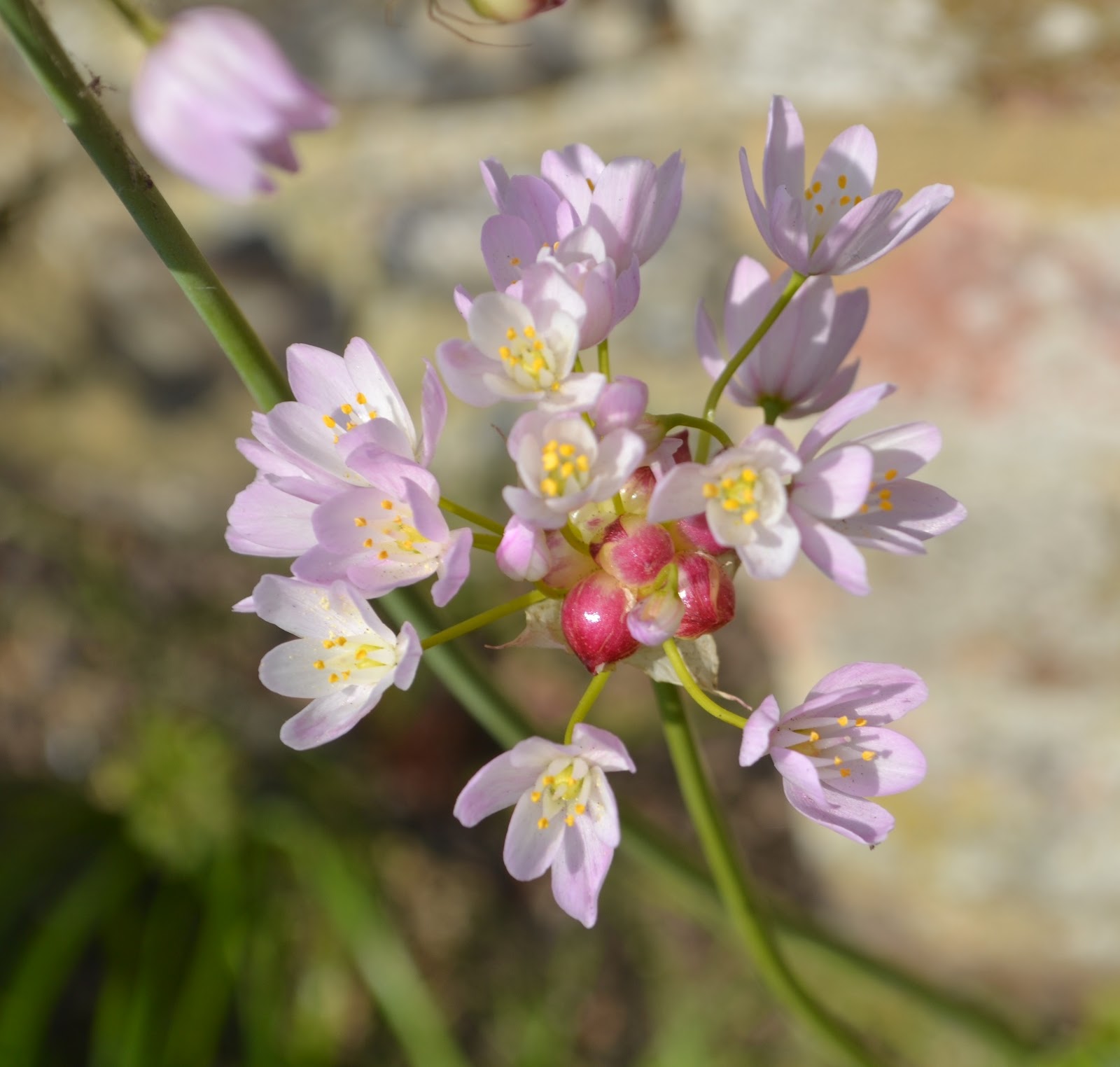
Rosy garlic

The trail continues across the A4130 and led into the centre of Nettlebed, and by a series of allotments took us to another road where Bushes Lane also emerges on the left.  We took this un-surfaced lane all the way to Huntercombe-end Lane.  As it passes Bushes Farm it is a reasonable guess that the name has nothing to do with anything botanical but refers to a farmer named Bush!  Even so it is obviously an ancient route, sunken a little in places between banks, which themselves are topped by coppiced hazels and larger trees that were once laid long ago, though it is probably no older than late medieval. 

Old laid hedge along Bushes Lane

There is the occasional ancient tree, indicating an age of several hundred years at least.  The oak Quercus robur right at the beginning of the lane (which can be seen best from the path through the allotments) was at least 350cm in girth, and a beech just after it was 476cm, a truly phenomenal tree.  We only noticed later that the OS map marks an “Oak” along Bushes Lane where a field boundary reaches it from the south. We presumed this was an ancient boundary marker tree, but we had not seen it, perhaps something else took our attention as we passed, so if anyone else knows anything about this tree, and whether it still exists, we would be interested to know.  Very few trees reach the status of being mapped by the OS!
At Huntercombe-end Lane we turned left and followed it to a footpath on the right, just after a couple of houses, took us through Park Wood (taking a left hand path through the centre of the wood to the western corner, avoiding the one even further left that is not a public right of way and goes along the south edge of the wood).  This wood again had plenty of yellow archangel and bluebell, although most of the latter were by now in seed.  On a tree-stump near the end of this path we saw yellow slime-mould Fuligo septica var. flava (otherwise known as dog-vomit slime-mould!), which can move across a wide area stealthily in search of food.  We came out of the wood on the A4130 again and walked alongside it to just past the Crown Inn, where you reach the Ridgeway Trail crossing the road.  Opposite the Crown, in the verge, was a clump of spiked sedge Carex spicata.  On the right is a small wood, Gangsdown Hill Wood, which, according to our notes (we no longer remember where the information came from) is a prime spot for woodruff.  It may have been so once, but now all the patches of woodruff are swamped by dog’s mercury.
We crossed the road, which takes some patience awaiting gaps in the fast traffic.  Steps up the bank took us along the marked trail and then through the golf course which now encompasses the whole of Nuffield Common.  The common is marked as “access land” but that is contradicted by notices telling walkers to beware of golf balls and not to leave the route marked by white-marked posts.  The common was probably once a pleasant heath but all that remains of that now is the odd clump of heather Calluna vulgaris or gorse Ulex europaeus marooned in a sea of closely mown grass.  We emerged at the road into Nuffield (only a handful of houses) opposite the church, turned right and then left to continue the trail southwards beside a barley field and then along a narrow belt of beech trees, with more goldilocks buttercup and wood anemone beside the path, and plenty of bluebell, wood melick and wood millet Milium effusum.
The Ridgeway Trail turns right to follow Grym’s Dyke instead of the Ridgeway, but we kept straight on to Ridgeway Farmhouse, which must have been on the original Ridgeway, though there is no evidence of the ancient route here at all.  The path goes round the Farmhouse, showing presumably that it was built right upon the ancient road, and then continues south, crossing two lanes, the second one at Homer Farm.  The trail from here is fenced tightly on both sides and has been allowed to grow to tall nettle for 200 metres.  We were unable to avoid getting stung.  Eventually we were relieved to reach Ipsden Heath wood once more, climbing up the hill past lots of woodruff and turning left along another track to reach the road where we were parked.

Sunday, 20 May 2012

Oxfordshire/Buckinghamshire: Chiltern Bluebell Woods around Stokenchurch

13th May 2012                         OS Explorer 171 Chiltern Hills West
Length: All day.

Bluebells, Cowleaze Wood
Woods in the Chilterns vary from chalk to clay subsoil and even more considerably in terms of management.  The best-managed can have a rich and colourful under-storey of spring flowers, but many are merely green swathes of dog’s mercury Mercurialis perennis or woodland grasses, and others are virtually devoid of ground vegetation altogether.  All types occur in this walk.  There are also many steep slopes (it is the Chilterns!).
          We started from the car park at Cowleaze Wood SU725955 in Oxfordshire.  This is one of the finest native bluebell Hyacinthoides non-scripta woods in the vicinity, but we initially left it by walking south along its western edge and then crossing the road to take the footpath to the open access area on Shirburn Hill (the second of the two paths, leading SW).  The strip of woodland reaching the road here has wood anemones Anemone nemorosa. 
Wood anemone
The path leads across improved pasture dominated by bulbous buttercup Ranunculus bulbosus, where we disturbed a pair of red-legged partridge, but also crowds of black march-flies Bibio marci that were emerging from the wet grass and blundering into our faces clumsily.  Fresh leaves were just emerging on oak Quercus robur, ash Fraxinus excelsior and beech Fagus sylvatica. 
Ash leaves emerging

Young beech leaves

The path crosses a short section of private beech and larch woodland on the Chiltern escarpment, where bluebells were mixed with yellow archangel Lamiastrum galeobdolon, which always makes a good sight, like a disordered Swedish flag.
 Yellow archangel

We soon reached an open area of south-facing escarpment past some old beeches on the right.  This would presumably once have been typical chalk grassland, with a mixed scrub of extensive juniper Juniperus communis and spreading box Buxus sempervirens (native?) on the mid-slope, and leached-out soils above with many acid-soil indicators like tormentil Potentilla erecta and patches of heather Calluna vulgaris. The heathers were just over the fence at the top (the crest of the hill is not part of the open access area), 
Juniper and box scrub

The open area is full of mossy old anthills (still active with their inhabitants, the yellow ants Lasius flavus). 
Shirburn Hill: anthills and view

A close look, however, reveals that virtually the whole turf is covered with rock-rose Helianthemum nummularium, unfortunately only just coming into bud at this time.  Given that rock-rose is a woody plant that is really a dwarf shrub, then one could say that the whole hillside is covered in scrub.  Indeed, Shirburn Hill is one of the favourite haunts of mycologist Penny Cullington, who finds a huge variety of rare woodland fungi here associated with the rock-rose rather than the more usual beech, oak and other trees of the Chilterns.  This site may well be ecologically unique.
          Several trees are scattered around, especially towards the top – including evergreen oak Quercus ilex, white beam Sorbus aria (a splendid old one with multiple trunks sprawls low to the ground in one place, its grey-white leaves just unfurling looking very attractive at this time of year), beech, and pedunculate oak. 
Whitebeam on Shirburn Hill
One of the oaks had a good covering of lichens such as Xanthoria parietina, Ramalina fraxinea, Parmelia sulcata and P.caperata, along with dark orange growths of a dry fungus Tremella mesenterica (“Yellow Brain” from its colour when fresh). 
Lichens and Yellow Brain fungus

This was the micro-haunt of a small brown bristly weevil Strophosoma melanogrammum, which is common on oak and can be a forestry pest.  It is interesting for the fact that only females are known and it reproduces parthenogenetically (but obviously very successfully).  There were also shrubs of spindle Euonymus europaeus, many of the fresh leaves already having the typical rolled leaf margins caused by the mite Stenacis convolvens.
          Still competing successfully with the rock-rose, especially on the anthills, were wild strawberry Fragaria vesca,
Wild strawberry

glaucous sedge Carex flacca,
Glaucous sedge

spring sedge Carex caryophyllea (with their top male spikes conspicuously bulbous while in flower),
Spring sedge

field woodrush Luzula campestris, common dog-violet Viola riviniana, last year’s carline thistles Carlina vulgaris, dwarf thistle Cirsium acaule, common milkwort Polygala vulgaris, biting stonecrop Sedum acre, mouse-ear hawkweed Pilosella officinarum, rosettes of ploughman’s spikenard Inula conyza, salad burnet Sanguisorba minor, bugle Ajuga reptans, common valerian Valeriana officinalis, sheep’s sorrel Rumex acetosella, and, a rarity in the Chilterns, early forgetmenot Myosotis ramosissima, its tiny flowers needing a close look to see, but far more abundant than field forgetmenot Myosotis arvensis here. 
Early forgetmenot

This was a strange mixture of chalkland and heathland plants – despite the leaching of the soil the chalk was very close to the surface, as shown where rabbits or badgers had dug holes.  Also frequent all over the slope were delicate little dandelions Taraxacum Section Erythrosperma, of which we identified a couple, T. fulviforme and T. rubicundum.  
Taraxacum Section Erythrosperma

Cowslips Primula veris were only to be seen beside the footpath along the bottom of the slope.
          It was too early to see the wealth of toadstools associated with the rock-rose.  There was a little Amethyst Deceiver Laccaria amethystea, normally only encountered in woodland, but the others seen were the usual meadow or heath species such as Meadow Puffball Vascellum pratense, Common Funnel Clitocybe gibba (large amounts in one patch), and Psathyrella obtusata.
Common funnel

Dwarf Bell Galerina pumila, delicate and slender, was associated with the moss, which enlivened the anthills with a patchwork of greens, yellows and golden-browns, including Montagne’s Cylinder-moss Entodon concinnus (the golden species) and Broom Fork-moss Dicranum scoparium (fresh green), while the general turf between the hummocks was dominated by Spring Turf-moss Rhytidiadelphus squarrosus, with its distinctive reflexed leaves.  Out of the moss, when examining it, came the tiny black staphylinid beetle Stenus brunnipes with its eyes so large that the head was wider than the rest of its slender body.
Rock-rose growing through moss (mostly Montagne’s cylinder-moss)

Over all flew the red kites, brazenly sweeping low around us, birds that would be conspicuous all day.  Stonechats were heard in the scrub, while a herd of roe-deer was both “heard” and seen.  With the recent rainy overcast weather, and it being before 10 o’clock in the morning, we saw hardly any butterflies, just a single Dingy Skipper.  With a long walk still ahead we had to move on, taking a last look at the wide view of the plain below the escarpment before retracing our steps.
          Arriving back at Cowleaze Wood we walked north to the public footpath and took that east to the far tip of the wood.  Now we had time to take stock of the wide swathes of bluebells, many wood anemone leaves (though few in flower), wood-sorrel Oxalis acetosella, three-nerved sandwort Moehringia trinervia, and woodruff Galium odoratum, typical of the more floriferous Chiltern woods. 
Cowleaze Wood, where the trees have orange eyes

There is a sign from the path to the Bomber Memorial, a concrete pillar to commemorate the Halifax bomber that crashed here on 31 March 1944 after a successful raid over Nuremberg, killing all seven Canadian crew.  No-one knows why it came down here, only a few miles from base.  There used to be many wood and metal constructions around the wood, part of a sculpture trail, but there is no sign of these any more.  Begun in 1990 the trail was very popular with visitors (about 80,000 a year), but was abandoned in 2007 when funding ran out, many of the works being sold at auction.  So man’s touches soon disappear, but the bluebells still lord it over all.
          At the end of the wood the path descends steeply through arable and then sheep pasture to a drive leading to Lower Vicar’s Farm, where there were cowslips in the verge.
Sheep pasture

Cowslips in verge

We turned left and then right, passing just south of the farm – a cluster of houses, of which the original barn is a listed building, and where house martins were flying. 
Lower Vicars Farm

The grass slope to the east has plenty of scattered cowslips, but is also planted with garden daffodils Narcissus sp.  Here the red kites were mewing and mobbing a lone buzzard.  At the top of the slope the path enters Langleygreen Plantation, a young wood with lots of new planting, dominated by dog’s mercury, with plenty of wood spurge Euphorbia amygdaloides spikes standing up proudly in flower, several clumps of blackcurrant Ribes nigrum, their leaves with that unique aromatic smell that can only be described as “blackcurrant”, and a little bugle.
Wood spurge

Blackcurrant

Reaching the top of the hill within the wood, the path then descends again into the next dry valley through pasture created out of recently cultivated land.  A lone brimstone flew past us. 
The slope up the other side is wooded and the wood-edge marks the boundary of Oxfordshire and Buckinghamshire, into which we now ascended, taking the left-hand fork to the north side.  This is again a dog’s mercury wood with little else other than wood spurge, although we did see the odd primrose Primula vulgaris.  Only at the far NE corner at the edge of the wood, on the clay plateau, did we pass through a carpet of bluebells.  Here we emerged eastwards through rather rough arable land where we started looking for the rare cornsalad Valerianella rimosa that has been seen around Stokenchurch, but there were only ordinary annuals like parsley-piert Aphanes arvensis, field pansy Viola arvensis, and red dead-nettle Lamium purpureum.  A hedged track then leads into Stokenchurch village, a community sandwiched between the A40 and the M4 motorway, the noise of which is inescapable.  The path crosses through a little industrial estate where there is wasteland with plants like common storksbill Erodium cicutarium (which seems to be rare generally in the Chilterns), green alkanet Pentaglottis sempervirens and goat’s-rue Galega officinalis. 
Common storksbill

Green alkanet

An orange-tip was inspecting the plants of garlic mustard Alliaria petiolata.  Crossing the Ibstone Road leading to the M4 interchange the path reaches a lane that bears north then east (Green Lane) parallel to the motorway and to a footbridge over the M40 into the centre of Stokenchurch.  Cuckooflowers Cardamine pratensis flowered at the side of this path, and so did hedgerow cranesbill Geranium pyrenaicum on the ramp up to the bridge.
          On the other side of the bridge are allotments and clumps of common winter-cress Barbarea vulgaris in flower.  The lane leads past the cricket pitch to the A40, where we turned right and then crossed to Church Street.  Just past the church is the Royal Oak pub and here we could pick up the Chiltern Way, although it is not signed until you get further along, so is hard to find.  We followed the Chiltern Waythrough grassland and then an arable field with lots of black grass Alopecurus myosuroides and other common arable plants like field madder Sherardia arvensis and field pansy. 

Chiltern Way
through wheatfields

At a hedgerow the Chiltern Wayturns eastwards along it and beside more cultivated fields with parsley piert before crossing a farm track and more arable to reach a track called Collier’s Lane on the OS map.  We followed this east all the way to Bennett End where we turned left up Horseshoe Lane to the Three Horseshoes at the top of the slope, a good place for lunch.
Three Horseshoes, Bennett End

We returned down Horseshoe Lane to the footpath opposite it, which ascends a sunken lane by a few houses, with wood melick Melica uniflora and goldilocks buttercup Ranunculus auricomus flowering by the path, shrubs of red currant Ribes rubrum and spindle, and mature beech trees.  Along here we came across patches of flowering ramsons Allium ursinum, explaining why “wild garlic” had been in our risotto at lunch!  There were also patches of moschatel Adoxa moschatellina, a few plants still in flower, woodruff and wood-sorrel, as we bent round through a small wood to the top of the slope and eventually reached a lane past a war memorial surrounded by field woodrush.  We turned left and then right along Green Lane, a plant of shining cranesbill Geranium lucidum on the right, but then with houses both sides, apparently called “The City” according to the OS map. 
At the end we turned right down towards Ashridge Farm, where three footpaths start at the end of the paved lane.  We took the left-hand one which leads to Bottom Wood, a Nature Reserve well managed by the Chiltern Society. 
Bottom Wood

Male fern uncoiling in Bottom Wood
A wide ride leads along the bottom of the wood, although this is also a bridleway and gets very chewed up by horses.  It was pleasing to be back in another flowery wood with extensive bluebells, yellow archangel, woodruff, goldilocks buttercup, wood melick, wood sedge, and wood millet. 
Woodruff

Goldilocks buttercup

In many places the main ground carpeting plant seems to be lesser celandine Ficaria verna.  Towards the east end, where the bridleway runs along the southern edge of the wood, a path goes off to the left to an area that is being managed as chalk grassland, although it is still obviously recovering from having become wooded over at some stage, as the main grass was the common woodland one, false-brome Brachypodium sylvaticum.  A sparrowhawk flew over as we looked around to see the vigorous shoots and spotted leaves of common spotted orchid Dactylorhiza fuchsii emerging amid a scattering of cowslips.  Muntjac slots in bare muddy places showed that it was going to be a problem protecting the orchids from being eaten off.  Indeed, having returned to the track where we turned off, we saw a small notice about violet helleborines Epipactis purpurata that appear here later in the year and wire-cages that unfortunately have to be used to guard them from the deer.  We were too early to see the beginnings of the shoots of these orchids.
At the end of Bottom Wood a belt of beech woodland runs south and we followed the bridleway uphill through it to reach Studley Green.  This woodland is a stark contrast to the one we had just left, the ground totally bare of vegetation, let alone flowers.  Just before we left there was a patch of gooseberry Ribes uva-crispa, making up the trio of Ribes species one can expect to see in these Chiltern woods.  In this case, however, it looks likely to be an escape from the nearby houses.  We emerged on a short stretch of the Old Dashwood Hill (or Old Oxford Road) that has been by-passed by the modern A40, and along here was a milestone dated 1744 giving the distances as Oxford 20, London 34.
At Studley Green there is a choice of return route.  The choice is either “call a friend” and get a lift back to Cowleaze Wood, or take footpaths back towards Bennett End and pick up the morning’s route, or cross the A40 and follow footpaths south of Stokenchurch along a totally new route.  The problem with the last choice is that the paths are not very direct and zigzag a lot, most of the paths are also bridleways and dense horse traffic has made them uncomfortable for walking, and, while the route passes through a lot of woodland, most of this is of poor quality botanically.  (On the other hand, you have a good chance of seeing red deer!)
We took the third option but found it a bit of a drag.  Thirds Wood beside the A40 at Studley Green was muddy and uninteresting, and at the far west end had been invaded by a huge expanse of garden yellow archangel Lamiastrum galeobdolon ssp argentatum, hybrid bluebells Hyacinthoides x massartiana and clumps of drooping sedge Carex pendula, the fate of many Chiltern woods too close to habitations.
East Wood was quite fresh green with wood spurge and was a pleasant enough walk.
East Wood

UNTIL, that is, we reached the west end (separately demarcated as Hedgepit Wood) where a wide “road” of builder’s rubble extended along the route of the public footpath for hundreds of metres, making for an exhausting and dangerous walk over brick and tile rubble, broken glass and ceramics, and even cutlery (!).  It is incredible that someone has not been prosecuted over creating such a safety hazard.  This is apparently part of a plan to build a large sports stadium here, although it seems highly unlikely that the District Council would give permission for it in Green Belt and Area of Outstanding Natural Beauty.
Penley Wood is another woodland dominated by dog’s mercury with few other flowers, although there were primroses along the north-south footpath through it.  When we emerged on the west side of Penley Wood, south of Studdridge Farm there was a herd of ten red deer hinds and young bucks in the open fields.  They are regularly seen in this area apparently.  A few years ago one would not have seen red deer in the Chilterns, but they have begun colonising, following the muntjacs and roes, probably descended from park escapes.  While welcome in themselves, all deer pose a conservation problem in the Chilterns, where the woods, grasslands and their associated plant communities have evolved over centuries of being completely devoid of their grazing and browsing.  A chalk grassland bank at the top of the first field, on the north side of the footpath, is under Countryside Stewardship.  It has not been grazed or cut although it is no doubt used by the deer. We could only see a single clump of cowslips.
Commonhill Wood near Lower Studdridge Farm has extensive bluebells by the footpath.  The farm is now used as a base for a removals firm, but there is a high fence separating the woodland and the latter is relatively unspoiled.  We finally reached Langleygreen Plantation and could follow our morning route back to Cowleaze Wood and its welcoming bluebells.

         
Our shadows in the evening light